
How AI is changing video production (without replacing filmmakers)
AI has gone from novelty headline to everyday reality. It now sits inside our edit systems, captioning tools, noise reduction plugins and even some of the planning tools we use before a camera ever rolls. It is absolutely changing how corporate video gets made – but it is nowhere near replacing filmmakers.
For us at SilverSun, what has changed is where we spend our time. Machines are faster at repetitive, technical tasks, which means we can lean harder into what we do best: story, performance and solving business problems for clients.
How we actually use AI
Across our corporate work and post‑production, there are a few clear places where AI genuinely earns its keep. In pre‑production, we’ll often use AI to help get past the blank page. Once a brief is clear, we might ask an AI tool for a few outline options, a rough beat sheet or different ways to phrase a key message. We never copy and paste these outputs, but they’re useful prompts that we then rewrite in our own voice and in the client’s language.
As footage comes in, AI really starts to save time. Automatic speech‑to‑text and smart search let us jump straight to the grabs we remember from interviews instead of manually scrubbing through hours of material. For corporate content built around talking heads, that time adds up quickly. Some tools will now propose rough cuts, highlight reels or social‑length clips from a longer piece. Those edits are not something we would ever send to a client “as is”, but they can give us a quick starting point when timelines are tight.
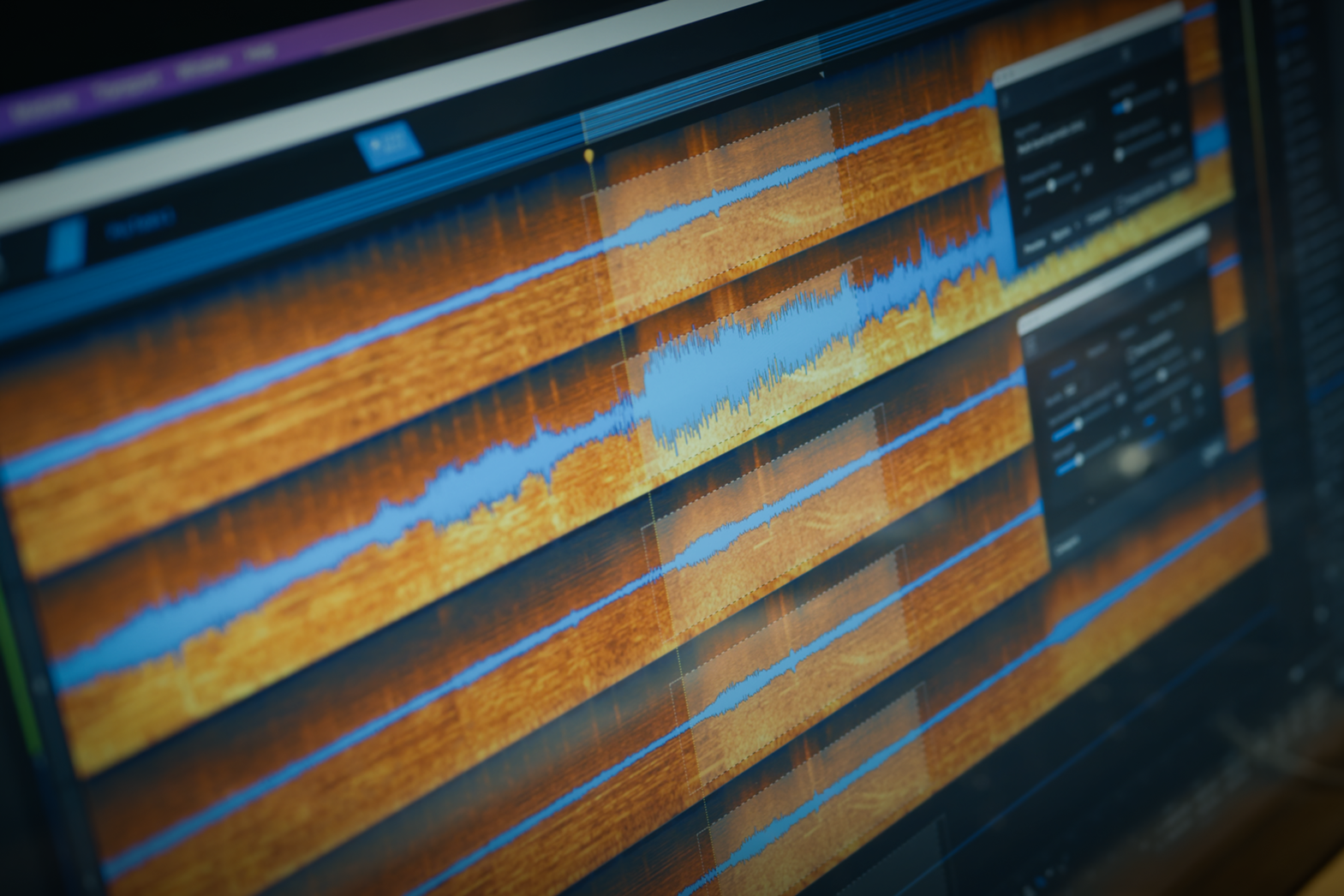
On the post‑production side, we are using AI and machine learning every day in audio. Dialogue clean‑up, dereverb, noise reduction, levelling – these are now handled by plugins that analyse the signal and make very smart first passes that used to take far longer by hand. We still listen, tweak and override, but the heavy lifting of fixing difficult recordings is far quicker and more precise than it was even a few years ago. The same story applies to picture: tools that help us tidy shots, remove small distractions or suggest looks are increasingly part of our standard toolkit.
We also lean on AI at the delivery end. Captions that used to be a chore are now expected as standard, and AI‑driven captioning plus basic multilingual support make it realistic to deliver accessible versions for different audiences without blowing out the budget. Format‑aware tools that help us create vertical or square versions from the main master also mean we can plan a shoot once and deliver across multiple platforms.
In all of these areas, AI speeds up the mechanical part of the work so we can focus on decisions rather than drudgery.
Where we don’t hand anything over
The hype can make it sound as if AI will do everything. In practice, the projects that work best for our clients still rely on human craft at the key points.
AI doesn’t sit in a room with stakeholders and ask, “What problem are we solving?” It doesn’t balance internal politics, audience expectations and brand constraints. Turning “we need a video” into a clear, achievable concept that lines up with a business objective is strategic work that comes from conversation and experience, not a prompt.
The same is true once we’re on set or in the studio. Corporate pieces live or die on how staff, leaders and customers come across on screen. Helping people feel comfortable, finding language that sounds like them and knowing when to push for another take or move on – that is hands‑on directing, not automation.
Even in the edit, where AI tools are most visible, there are limits. An algorithm can suggest cuts; it does not feel the rhythm of a performance, the weight of a pause or the payoff of a reveal. Editors and sound designers still make the calls on timing, focus and tone. Around that sits another layer of judgement. Decisions about representation, truthfulness, synthetic elements and deepfake risk need clear ethical thinking and an understanding of the brand and the audience. And over the top of everything is the relationship with the client: knowing how they like to work, where they’re heading and when they need to be challenged or protected. AI can sit in our toolkit, but it does not build trust.
The way we explain it to clients
On a typical corporate project at SilverSun, an AI‑assisted, human‑led process starts with a collaborative briefing session. We define the objective, audience, key message and measures of success together. We might use AI to throw around a few title options or angles, but the direction is set by people in a room, not a chatbot.
From there we draft a structure and key beats from the brief, sometimes testing variations or alternative lines with AI, and then shaping them back into something that sounds like the brand and the people involved. Production is fully human‑led: on set or in the studio we’re focused on performance, coverage and sound, and on capturing enough material to allow for future cut‑downs and vertical versions without compromising the main film. In post, we use AI for things like speech‑to‑text, selects, rough cuts and clean‑up, but the story, pacing, colour and mix are all crafted by our team. At the end, AI helps with captions and format variants, and then we manually check and tweak everything before it leaves the building.
When clients ask how we use AI, we usually put it simply: we use AI to do the boring parts faster, so we can spend more time on story, performance and accuracy. Then we explain which tools we use and at what stages, what safeguards we have around accuracy, privacy and brand reputation, and what remains 100% human‑led in our process.
For us, AI is not something to fear or to worship. It is a new layer of infrastructure. Used well, it lets us move faster, experiment more and spend more of the day on the parts of the craft that drew us into filmmaking and post‑production in the first place. For corporate teams, the opportunity is to partner with people who take that balance seriously – crews and post houses who are fluent in the tools but still judge success by the same things you do: clarity, impact and business results.